THE AMHERST STUDENT
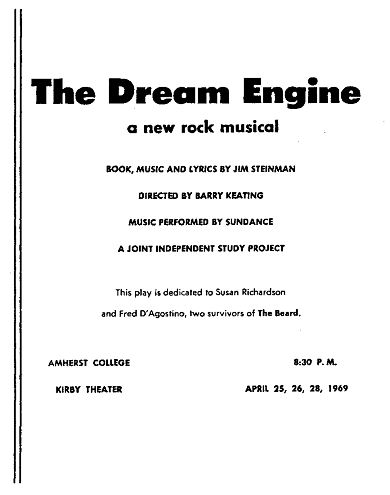
'The Dream Engine'
By E.A.H.
The much-publicized Rock Musical, The Dream Engine, which opened last week at the Kirby Theater in Amherst and later played at Mount Holyoke, is not the stuff that musical entertainment is usually made of. Rather it is a disturbing student protest in fantastic modern, motley satire based on a thoughtful premise and sincere purpose. In one of their advance publicity photos a group of young people was shown with sad faces and arms outreached, their spread fingers suggesting the taut hands of people drowning in a flood grasping frantically for any floating straw. It was a moving picture quite beautifully symbolic of the meaning of their production which this reviewer felt it a privilege to see. That it was a success is evidenced by the fact that Joseph Papp of New York Shakespeare Festival fame and the producer of the controversial "Hair" has already optioned it for professional production. Locally it was enthusiastically received.
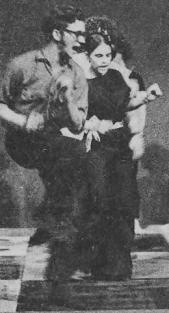
two choreographers for The Dream Engine
Both the musical score and the libretto are the work of an Amherst Independent Scholar, James Steinman, who also played the leading role. "Mr. Steinman has all the intensity of a very "Angry Young Man" (an out-moded but still apt expression). He has progressed to an objective state of considerable wisdom. True, he is still indignantly - even vindictively aware of the generation gap, a vacuum he does not dare to cross. But it is true also that with some positive thinking he has arrived at the conclusion that anarchy is not the answer. He seems to have a message of warning for his revolutionary contemporaries. As for the elders in the temple - he says "to hell with them!" They can listen if they want to. We believe they should. Mr. Steinman demonstrates that the recent image of the ubiquitous "Hippie" has been replaced by a far more sinister figure of violence and destructiveness. It is an alarming vision for the older generation chiefly because honest reason and logic lay the matter squarely in our guilty laps; the state of the world today; the pointless Vietnam War; the brutality of political assassinations; the hypocrisy of moral attitudes - especially about sex; the organized church and out-dated education. The young author is indeed a "Daniel come to judgment!" the youthful prophet who with apocalyptic vision read the writing on the wall predicting the fall of Babylonia and the cataclysm to come. He has much to say and says it well in articulate poetic form that is, however, needlessly loud, and needlessly long and sometimes, needlessly obscene. As theater it is more propaganda or protest than good drama. As a combination it is an affirmative and moving experience.
The story deals with a group of young men and women who have reverted to a violent primitive life somewhere on the coast of California. Led by a dynamic young savage whose name is Baal (the false god of the Hebrews was the obvious prototype). The objective of this band is conversion of others to their belief in anarchy and destruction of all existing aspects of the old Establishment. The author carries the plot courageously to an inevitable ending climaxing the whole anarchical lot of them in fearful self-immolation. Like the Emperor Jones they become victims of their own terror. As Karl Marx stated that Capitalism carries with it the seeds of its own destruction so the author of The Dream Engine (can it signify a computered chaos?) demonstrates that complete repudiation of the status quo would mean the end of it and oblivion. In other words, the play suggests no "Brave New World" by wiping out the old one. Instead it has a moral and a very cogent one.
As entertainment it was very exciting in an extremely primitive way with all the elements of defiance of the Establishment; the ear-splitting noise of the foghorn Rock and Roll music coupled with the superfluous mighty "Mike" that hid rather than carried the words of the songs and speeches; the wildly wonderfully acrobatic movement verging upon libidinal ferocity; the four-letter words; the sweaty dirt; the lack of humor other than the shock of obscenity. The whole picture achieved a frightening violence that was nakedly assertive. Yet here, this loving critic must sadly but honestly opine; that artistically there is a deadening effect in such excess; that too much permissiveness defeats rather than enhances; it dehumanizes what it touches reducing people to puppets, making commodities of human beings. It removes the dimension of depth which is the difference between man and animal. And combined with the tautology of the drum beat it reduces the audience to a condition of mad frustration. But perhaps that was the author's intent for in his own words he asks, "Whoever said that madness was a sin?"
The director, Barry Keating, handled the whole production with skill and imagination, the choreography of the ballet scenes was dramatically arresting, the movement broadly expressive but controlled. The actors were all high-keyed in theater-of-the-absurd style. Barry Keating who doubled as director and actor played the befuddled Historian with color and humor, too lengthy by far, but well done. As the leading character, Baal, the author James Steinman was electrically charged but sometimes obtrusively demanding with his blasting of the "Mike." The character of Max in the hands of Stephen Collins was a realistic portrait of a frustrated reactionary in a relatively lower key and Sarah Harris was a strongly convincing symbol of the Establishment making the argument of the opposition valid and persuasive. But in the important role of The Girl pretty Ellen Parks was unhappily ineffectual in voice - her vocal chords frozen either by stage fright or the sheer horror of her scenes. The dancers were superlative individually and as a group. The music by the Sundance group of Amherst was important and competent supporting the action's every mood. More melodic perhaps than most Rock and Roll music it nevertheless - and because of the insistent demands of the theme - was lacking in subtlety and variety. The persistent loudness was hypnotic but ossifying.
Altogether it was an evening that should have stimulated the most lethargic. Such shock treatment that could even "waken the dead" or at any rate the half-dead as a lot of us unintentionally are. We need awakening and soon. In the words of a wise elder opinionator, "The only way to meet youth's unrest is with adult unrest." Thank you, Mr. Steinman. Personally, after seeing and hearing "The Dream Engine" I did not sleep well. I was not only classically "purged with pity and terror," I was haunted by guilt and by the beautiful poetic imagery of those young and reaching hands.