Something Dark But Lyrical Inside
TUNED-UP WHISTLE TAKES ON THE SOUND OF SUCCESS LLOYD WEBBER'S FOUR NEW ASSOCIATES GEAR UP FOR SHOW'S OPENING NIGHT
by Nelson Pressley
The Washington Times


Let's say you are the most successful composer the musical theater has ever known. Your next show is guaranteed to attract scads of attention; brilliant or lousy, it's going to be news. Would you hire a lyricist, a librettist, a set designer and a choreographer with whom you had never worked?
Andrew Lloyd Webber has, and the reason is simple: "Whistle Down the Wind," which opens Wednesday at the National Theatre (and, barring any disasters here, at the Martin Beck Theatre on Broadway on April 17), was originally supposed to be a movie. When 20-time Tony Award winner Harold Prince, the director of Mr. Lloyd Webber's "Evita" and "Phantom of the Opera," got interested, the winds behind "Whistle" began to blow toward Broadway, with much of the creative team that had been assembled for the film in tow.
That explains what Jim Steinman, the songwriter of rocker Meat Loaf's best-selling 1977 album, "Bat Out of Hell," is doing at the National these days. Likewise Patricia Knop, screenwriter of "9 1/2 Weeks," the steamy Kim Basinger-Mickey Rourke movie.
Mr. Steinman and Miss Knop are well-established in their fields, but they are utterly new to Broadway. Set designer Andrew Jackness and choreographer Joey McKneely are theater veterans, but they, too, are getting their first taste of the Hal Prince-Andrew Lloyd Webber experience.
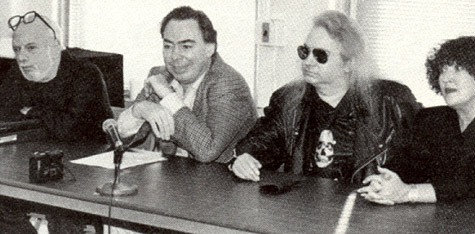
Is the fabled out-of-town tension getting to them on their first excursion with these two titans of Broadway? Not noticeably. They seem to know that if the ax falls, it will lop off bigger heads than theirs. And anyway, everyone seems to feel protected by the aura of success radiated by Messrs. Lloyd Webber and Prince.
As Mr. McKneely, perhaps the most cocooned of the four, says admiringly: "Hal knows. He just knows. Nobody knows as much as Hal."
THE SET DESIGNER
"Whistle Down the Wind" is based on Mary Haley Bell's novel (made into a movie in 1961) about three children who find a stranger hiding in their barn. The children think he is Jesus; the townspeople think he is a murderer.
The book and movie are set in northern England. The musical, on the other hand, is set in 1950s Louisiana. Mr. Jackness shares a lot of the responsibility for making that transposition effective. He is also working in the shadow of spectacle-heavy Lloyd Webber megamusicals that continue to hold the stage.
"In the simplistic, painterly images that we've used, we are actually going back to an older stagecraft, and a simpler stagecraft," says Mr. Jackness, who has designed plays, films, ballet and opera all over the country. "But I think that the images will be striking enough that the audience won't be asking, ‘Where's the chandelier?’ "
It's Tuesday, Nov. 12. Mr. Jackness has already been at work on the set in the theater for six weeks. A press event has been arranged for this afternoon, during which the genial, soft-spoken Mr. Jackness will be expected to perform a sort of show-and-tell with his creation. While a television crew tangoes with its lights and tiptoes through an undergrowth of cable, Mr. Jackness relaxes in the Helen Hayes Gallery upstairs at the National and explains why "Whistle" will look somewhat different from other Andrew Lloyd Webber shows.
What's complex about this musical, he says, isn't the images themselves, which was overwhelmingly the case in Mr. Lloyd Webber's last show, "Sunset Boulevard." In "Sunset," designer John Napier wowed the crowd by finding theatrical ways to pulloff cinematic stunts that included a car chase and a split-screen effect with a levitating stage.
In "Whistle," scenes are more likely to be set with scrims and flying drops than with hydraulic lifts. The complicated thing, says Mr. Jackness, is the way "Whistle" moves from one image to another. The desired effect, as always with major modern musicals, is cinematic fluidity.
The barn goes on and off the stage a number of times, and the audience gets several different views of it. But no one seems to think that The Barn is going to enter theater language the way The Helicopter (from "Miss Saigon") and The Chandelier (from "Phantom") have done. The designer insists that while this isn't quite the "minimalist" affair that Mr. Prince, the director, has called it, it still isn't high-tech stuff.
"It's a middle-tech set," says Mr. Jackness, with a deeply dimpled smile.
This morning's New York Times review of Mr. Lloyd Webber's resolutely low-tech "By Jeeves" - having its American premiere at the Goodspeed Opera House's Norma Terris Theater in Chester, Conn. - quotes Mr. Lloyd Webber as saying that the era of musical spectacles is over.
"I don't know how true that is," Mr. Jackness says. "It may be true for him, because it's an expectation that the audience has. I think that he made a very specific point in this piece not to have a set overwhelm the action."
Likewise, Mr. Jackness says that Mr. Prince didn't want the show "to feel technical."
He is not worried about the barn suddenly crashing around the stage during previews and knocking the actors into the orchestra. But he says his nerves may tighten a little now and then.
"The thing that's nervous-making is really the unknown," the designer says, "and what you're going to find as you go along. But the excitement comes from seeing something for the first time, and seeing things you never thought were there."
The "nervous-making" and the exciting sound perilously close to the same thing.
THE LIBRETTIST
This is Patricia Knop's first Broadway musical. Yet it's a job she feels she was destined to have.
It started when her friend Jim Steinman called her one day to say he was going to France to talk to Andrew Lloyd Webber about working on his next musical.
"I sort of laughingly said, ‘If you need help, just call and I'll be right over,’ " said Miss Knop (pronounced Ka-NOPP) two weeks ago from her home in Santa Monica, Calif.
The next day Mr. Steinman called, and Miss Knop did indeed hop on over to France. She recalls that before the night was over, Mr. Lloyd Webber was confident enough in her that he announced, " ‘This is a done deal.’ " Miss Knop was on board.
The odd thing was that Miss Knop - who won't reveal her age but says she's old enough to have a 30-year-old daughter - was already at work on a story just like "Whistle Down the Wind." Miss Knop's project was based on an incident in New Mexico, where she and her husband, the producer and director Zalman King, have a home. Apparently, a woman discovered a man hiding in her barn and thought he was Jesus.
So when "Whistle" came along, Miss Knop naturally felt it was in the stars for her to be involved.
Still, she has no illusion that she would have been chosen for this job if the original plan hadn't been to turn "Whistle" into a film. Miss Knop had already written three musicals with Mr. Steinman, each intended for movies, none yet produced. She is a screenwriter whose greatest fame came with a string of mildly erotic movies that she penned with Mr. King in the 1980s: "9 1/2 Weeks," "Wild Orchid" and "The Red Shoe Diaries."
So what can the author of hot 'n' heavy Hollywood flicks bring to an Andrew Lloyd Webber musical?
"I hope I'm bringing several things," Miss Knop says. "One is that I'm pretty experienced at storytelling at this point. I've written 43 screenplays. Not all of them are highly sexy, but all of them come from a highly romantic point of view. What I'm basically dealing with is the element of love, or the lack of it. And I don't feel that's too far away from the things we're dealing with in Whistle Down the Wind. "
She also brings a longtime affinity for Mr. Lloyd Webber's music, particularly "Evita" and "Phantom of the Opera."
"It's like it has something that I need emotionally, that expression through music and that kind of heightened reality," Miss Knop says. "And it's something I've done a lot of work with in my life."
She doesn't mention one of the most interesting of the several coincidences that seem to have lured her to this musical. It is Mr. Steinman who reports that Miss Knop's middle name is Louisiana.
THE LYRICIST
Jim Steinman is late for a 1:30 interview. Word comes to an office upstairs at the National that "Jim just got sucked into a number with Hal" and that he is not likely to break free at all this afternoon. A heavy rock backbeat pounds through the theater's walls and into the otherwise placid administrative wing that overlooks Pennsylvania Avenue.

Twenty minutes later the grinning Mr. Steinman, with gray hair hanging below his shoulders, strolls in wearing blue jeans, a blue oxford shirt, sneakers, a black leather jacket and a black necktie that has on it the image of a skull. A woman's face floats in each of the skull's eye sockets.
"That's what I like - something dark, but lyrical inside," Mr. Steinman says. "And if I can't create it in my art, at least I have this tie."
Mr. Steinman is probably the best-known songwriter (as opposed to performer-songwriter) in rock. He wrote the music and lyrics for Meat Loaf's 1977 debut album, the best-selling "Bat Out of Hell." His calling card is the "power ballad," love songs of near-operatic scale. For an example, listen to Celine Dion's "It's All Coming Back to Me Now," the latest Steinman creation to soar up the charts.
"I use more chords in the opening of that song than Janet Jackson has used in her whole career," Mr. Steinman says.
"On the tightrope of being thrilling and silly" is how he describes his work, and Mr. Lloyd Webber's, and Miss Knop's, and most of his favorite rock and opera. He sees "Whistle" as a chance to bring theater's lyrics into the rock era.
"Rock 'n' roll really transformed lyrics starting in the mid-1960s - well, starting with Dylan and then going on through the Beatles, et cetera," Mr. Steinman says. "And that really changed the way lyrics were conceived and composed: much more compressed, imagistic, heightened language. And that never gets talked about, and that hasn't been used in theater. Theater tends to have very literal lyrics."
Mr. Steinman actually started out in the 1970s trying to create musicals at the New York Shakespeare Festival for the legendary producer Joseph Papp, who threw an ashtray at him when Mr. Steinman said he was leaving the theater to make records.
When Papp asked him why he was giving up on theater, Mr. Steinman recalls saying, "I look out at the audience every night, and all I see is old people and their parents."
Several things have drawn the irreverent Mr. Steinman back to the stodgy old theater world. Collaborating on a musical, he says, is more stimulating than making records, which involves long hours with only two or three people stuck in "an incredibly sterile place."
More significantly, Mr. Steinman thinks that audiences have changed, thanks in no small part to Mr. Lloyd Webber. Rather than appealing to a coterie crowd in a single New York City theater each night, Lloyd Webber musicals attract huge throngs in cities across the country and around the world.
Mr. Steinman notes that when trade magazines such as Billboard and Radio and Record report on the top-grossing concert tours, "Phantom of the Opera" and "Cats" hover near such acts as Metallica and Guns N Roses.
Which explains why Mr. Steinman feels remarkably comfortable en route to Broadway: Andrew Lloyd Webber is musical theater's answer to Pearl Jam.
THE CHOREOGRAPHER
If out-of-town tryouts are supposed to be pressure cookers, choreographer Joey McKneely isn't showing it.
On his lunch break two days before Thanksgiving - or, to put it more meaningfully to the "Whistlers," 10 days before the first performance - the heavy-lidded, soft-voiced Mr. McKneely has a sleepy-happy look as he leans back in the chair that Mr. Steinman just vacated. He's so laid back he gets his simile jumbled up.
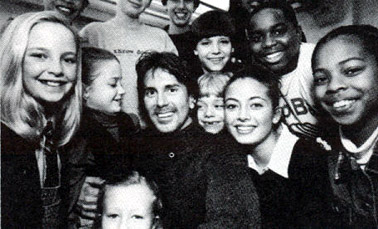
"I'm as relaxed as a cucumber," he says.
Is everyone downstairs this cool?
"I don't think so," says Mr. McKneely, who just turned 30. "Hal is very intense. He yells a lot, and he yells into the mike a lot. That's just what he does; that's him."
With the intensity way up and with so many assistants and designers and stagehands scrambling to make a complicated show look seamless, Mr. McKneely has decided that the best thing he can do is go about his business quietly. And anyway, his work is essentially done.
"I've had five weeks of rehearsal to fine-tune two numbers, maybe three," he says. In "Smokey Joe's Cafe," which earned Mr. McKneely a Tony Award nomination for best choreography last year, there are 39 numbers. In that situation, he says he was less cucumberlike, "more wired."
In "Whistle," all the choreographer has to work with is what Mr. McKneely describes as a sort of pop song set in a bar, and "a snake-worshiping number."
"I'm almost secondary to what's going on," Mr. McKneely says. "My numbers have a certain purpose, and they do what they need to do. I think they're very effective for what they are. But the show is not going to make or break on me."
Though the workload in "Whistle" is relatively light, Mr. McKneely hasn't taken it lightly. He did research on cult worship for the snake-dance number, and he read the entire Bible for the first time.
And the light load hasn't necessarily translated into easier work, since the "Whistle" cast is mainly made up of actors, not dancers - which means that in a sense, he's working on scenes, not numbers.
Another reason the fabled out-of-town tension isn't getting to Mr. McKneely is that he feels that "Whistle" is a sure thing.
"That may be a little presumptuous of me, but with Hal Prince and Andrew Lloyd Webber, it's going to sell," the choreographer says. "Now whether or not it becomes a ‘Cats’ or ‘Phantom’ is a whole different matter. But it will have a respectable run."